Teufelsberg: the American listening station on a hill of rubble
The stories in our games are fiction. This page is only fact, with its sources, so you can read it on its own.
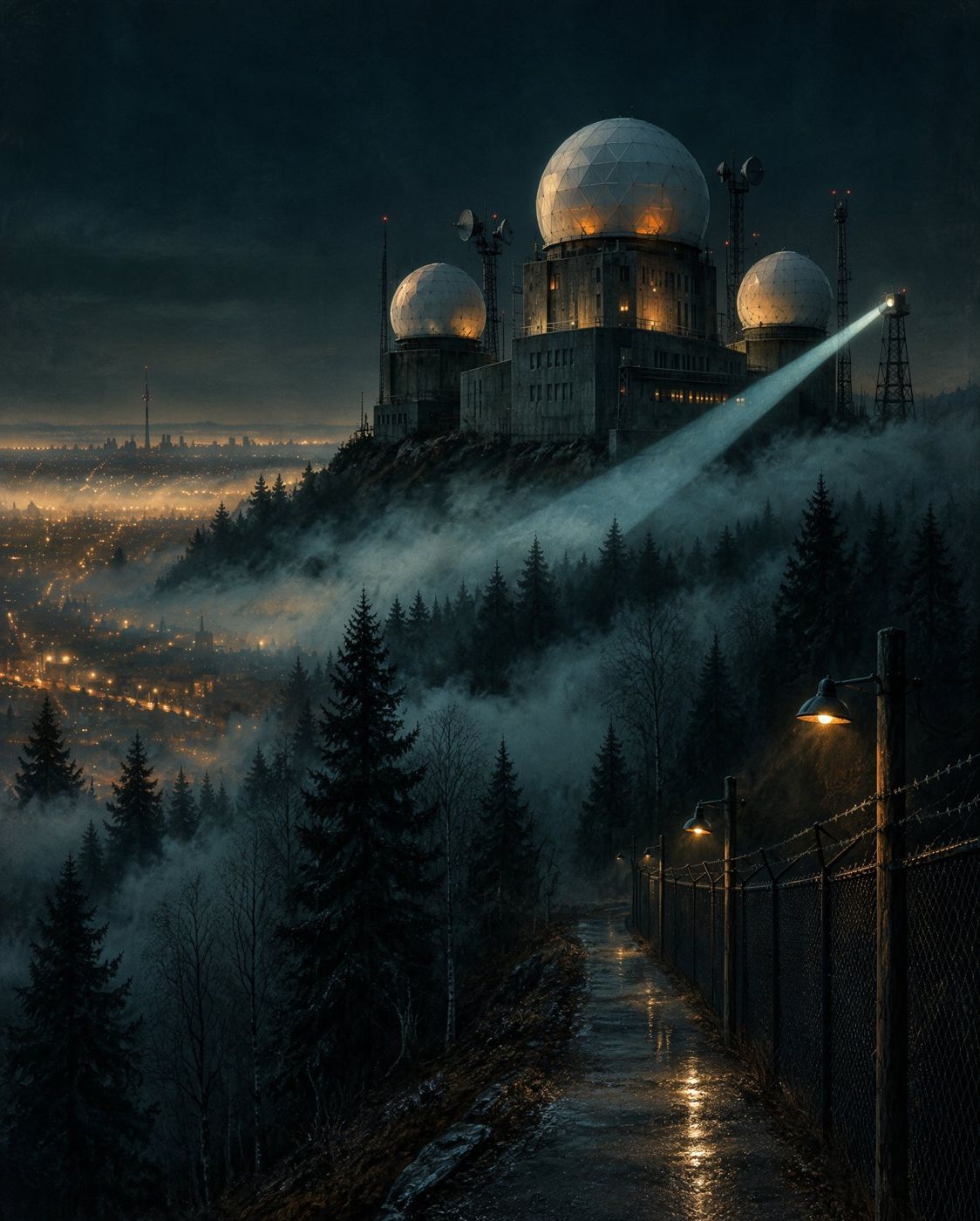
On the western edge of Berlin, in the Grunewald forest, stands a hill that should not exist. Berliners call it Teufelsberg, the Devil's Mountain. It is not a mountain at all. It is the ruins of the city itself.
A hill made of a destroyed city
At the end of the Second World War, Berlin had lost over 400,000 homes and was left with an estimated 75 million cubic metres of rubble to clear (Amusing Planet). Much of it was carted to the Grunewald and piled up. Today the hill rises about 80 metres and buries an unfinished Nazi military training school that could not be blown up (Lonely Planet).
Why spies wanted a hill
West Berlin was an island of the West, surrounded by East Germany. For radio intelligence, a high point in the middle of enemy territory was priceless. The first American mobile listening units took up position on the hilltop in July 1961, permanent buildings followed in 1963, and the site grew into one of the West's largest spying stations (Abandoned Berlin).
Its official name was Field Station Berlin. It was run by the US National Security Agency (NSA), and the Allies who worked there simply called it "The Hill". Berliners had their own nickname for the white radar domes on top: "Berlin's Balls" (Amusing Planet). Under the domes, huge antennas intercepted, recorded and jammed radio signals from the Eastern Bloc (visitBerlin).
The listening went both ways. The Soviets had their own station on a hill in East Berlin. Christopher McLarren, who served on Teufelsberg in the 1970s, put it simply: "As long as they listened to the West, and we listened to the East, things went fine" (The World).
November 1983: the most dangerous autumn
The Hill is set in November 1983, and the date is no accident. On 26 September 1983, a Soviet early-warning system reported that the United States had launched nuclear missiles. It was a false alarm (Business Insider).
Weeks later NATO ran Able Archer 83, a command exercise that practised the steps leading up to a nuclear attack. Soviet leaders grew convinced it could be cover for a real first strike; the exercise ended without incident on 11 November and Soviet forces stood down (Global Zero). A secret US history later described this as the moment "Cold War hysteria reached its peak" (Foreign Policy). Historians still argue about how close the world really came.
The codes are real too
The puzzles in The Hill use methods that Cold War spies really used.
Numbers stations and one-time pads. Shortwave stations read out long groups of digits to agents in the field. Numbers stations were most abundant during the Cold War, and the messages were typically encrypted with a one-time pad, a method considered theoretically unbreakable when used correctly (Wikipedia). The pad is a sheet of random five-digit groups; the receiver takes the same page from his own pad and recovers the message by "false subtraction", digit by digit without borrowing (War on the Rocks). That is exactly what you do at the radio set in our game.
Chalk marks. Spies signalled each other with marks in public places. On 13 October 1993, FBI investigators watched the CIA officer and Soviet mole Aldrich Ames draw a chalk mark on a mailbox to confirm a meeting with his Russian handlers in Bogotá (FBI).
Glienicke Bridge, the Bridge of Spies
A few kilometres from the Hill, Glienicke Bridge links West Berlin with Potsdam. The East German government called it the "Bridge of Unity", even as it kept the two halves of Germany apart (Cold War Sites). In the middle of this bridge, East and West traded captured agents:
- 10 February 1962. The Soviet spy Rudolf Abel was exchanged for Francis Gary Powers, the American U-2 pilot shot down over the Soviet Union (CS Monitor).
- 12 June 1985. 23 agents held in Eastern Europe were exchanged for the Polish spy Marian Zacharski and three others (Cold War Sites).
- 11 February 1986. The Soviet dissident Anatoly Shcharansky walked to freedom across the bridge (NBC News).
In all, exchanges involving 40 people took place on the bridge (Cold War Sites).
Teufelsberg today
The Americans used the station until the end of the Cold War (visitBerlin). The empty buildings and torn radar domes are now covered in street art, and visitors can walk up the hill for one of the best views of Berlin.
The Hill
Your team inside Field Station Berlin on a foggy night in November 1983: a forged pass, a numbers station in the static, and six suspects. Someone on the Hill is working for the other side.
Open The Hill